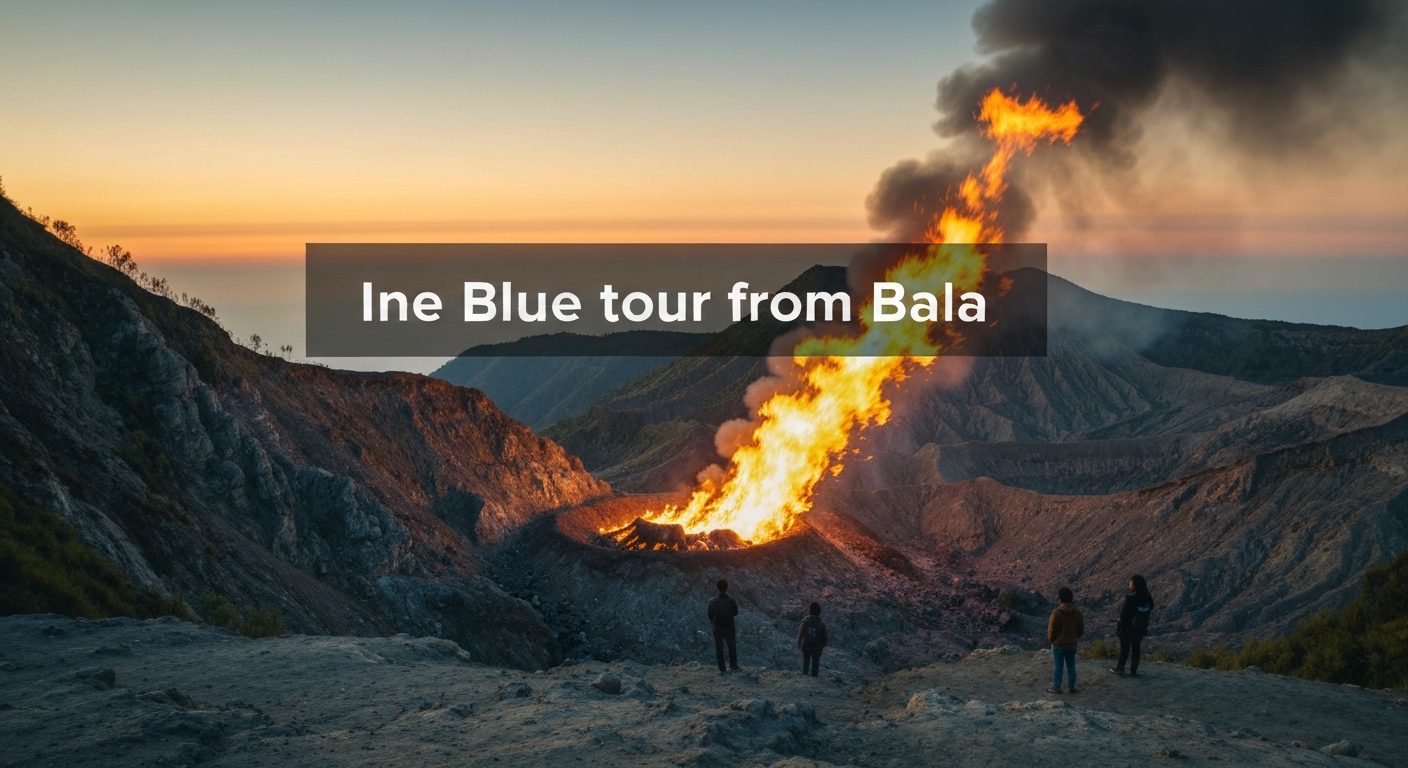
An ijen blue fire hiking guide is a step‑by‑step plan for safely seeing Kawah Ijen’s electric‑blue flames at night, with clear timing, safety and route advice. This page explains, in plain language, how the blue fire works, when it is visible, and what you actually sign up for on a 1 am crater hike.
I’m Mara, Bali–Java Circuit Editor at Bali Java Overland, operated by Bali Premium Trip. I still remember my first 00:30 alarm at a homestay near Banyuwangi, lacing boots in the dark and checking gas masks twice before driving up to Paltuding gate. This guide is what I now say to guests in the car the night before: realistic, detailed, and designed to replace vague worry with concrete steps.
What is the Ijen blue fire, really?
First, a quick myth‑bust. The “ijen crater blue fire” is not blue lava. You are seeing sulfuric gas igniting as it hits oxygen and burns with an electric‑blue flame along vents and cracks inside the crater.
- The crater lake is highly acidic (pH near 0).
- Sulfur deposits build up as bright yellow rock.
- Gas escapes under pressure, catches fire, and glows blue in the dark.
Because it’s burning gas, not solid rock, the flames are sensitive to wind, rain and how much gas is venting that night. Some nights the blue tongues are tall and obvious. Other nights they are low and diffuse.
The same geology that produces this light show also powers a hard, dangerous trade: sulfur mining workers in Ijen crater break and carry bright yellow blocks of sulfur up and out, often twice a day. Your blue fire visit happens inside their workplace and on top of an active volcanic system. That’s why safety and respect are the two main themes of any serious ijen blue fire hiking guide.
What time is the blue fire visible?
Visitors often ask “kawah ijen what time blue fire is visible?” and get vague answers like “in the middle of the night”. Here is the clear version.
- Usual viewing window
- Roughly 01:30–04:00, before the sky lightens.
- Gate opening
- Paltuding gate usually opens to hikers around 01:00–02:00, subject to park rules and current activity levels.
- Hike time to crater rim
- About 1.5–2 hours for most reasonably fit hikers, covering ~3 km and ~500 m of elevation gain.
- Descent into the crater
- Another 30–45 minutes down a steep, rocky path from rim to the blue fire viewpoint.
The constraint is simple: once nautical dawn approaches, the flames are drowned out by ambient light. You can still hike and see the crater and lake at sunrise, but the intense glow is gone.
That’s why a proper ijen night hike logistics timing plan starts from the blue fire visibility window and works backwards. If you leave your homestay too late, or your group moves very slowly, you will reach the crater right as the sky begins to brighten.
Ijen night hike logistics: a realistic timeline
This is how a typical night looks on the ground for Bali Java Overland guests doing blue fire plus sunrise, coming from the Banyuwangi side.
By hours: sample timing from Banyuwangi
- 22:00–23:00 – Try to sleep. Your guide will have briefed you after dinner on gear and safety.
- 00:15–00:45 – Wake up, quick snack, final check: layers, headlamp, gas mask, water.
- 00:45–01:00 – Drive from hotel/homestay in Banyuwangi area to Paltuding (about 1–1.5 hours via mountain road).
- 01:00–01:30 – Arrive at Paltuding. Park entry, meet crater guide, last toilet stop.
- 01:30–03:00 – Hike to crater rim at a steady, not‑rushed pace. Short rests built in.
- 03:00–03:45 – Descend from crater rim down the rocky path towards the lake and blue fire area, using gas masks near gas vents as needed.
- 03:45–04:15 – Time at blue fire viewing zone, depending on gas and crowd conditions.
- 04:15–05:00 – Climb back up to the crater rim in the dark or early dawn light.
- 05:00–06:00 – Watch sunrise over the acid lake (if weather allows), then start the descent.
- 06:00–07:30 – Hike back down to Paltuding, arrive as day visitors start coming up.
- 07:30–08:30 – Simple breakfast in or near Paltuding, then drive back down to Banyuwangi or onward towards Ketapang ferry or Bondowoso/Probolinggo.
This can shift by 30–60 minutes depending on season, crowding, official gate opening, and your walking speed. The key is that your feet need to be near the blue fire zone between roughly 02:30 and 04:00.
From Bali or from Bromo? How Ijen fits your circuit
Most Bali Java Overland guests are linking Kawah Ijen with Mount Bromo and a Bali base. The route shapes your sleep and stamina.
| Route pattern | Typical flow | Night before Ijen | Energy level for 1 am hike |
|---|---|---|---|
| Bali → Ijen → Bromo | South Bali/Ubud to Gilimanuk, ferry to Ketapang, overnight Banyuwangi, Ijen, then drive via Bondowoso to Bromo. | Banyuwangi hotel/homestay, early evening check‑in. | Usually best: one “normal” night before the 1 am start. |
| Bromo → Ijen → Bali | Bromo sunrise, drive to Bondowoso/Banyuwangi, overnight, Ijen at 1 am, then ferry to Bali. | Bondowoso or Banyuwangi, after a Bromo morning and 5–7 hour drive. | More tiring: many guests have had two short nights back‑to‑back. |
| Direct from Bali (no Bromo) | Bali to Gilimanuk, ferry to Ketapang, overnight Banyuwangi, Ijen, ferry back or continue to Java. | Banyuwangi, after a half‑day road journey. | Manageable if we avoid very late ferry crossings. |
If you’re nervous about the Ijen crater hike difficulty, we usually recommend putting Ijen before Bromo so your legs and lungs are fresher. That is the flow we design most often for Bali‑based guests, unless your flights or Java plans force a different order.
If you’d like an honest routing suggestion for your dates and energy level, you can plan your trip with our Bali Premium Trip reservations team via email or WhatsApp and we’ll map Bromo–Ijen–Bali in a way that actually lets you sleep.
Ijen crater hike difficulty: how hard is it?
The Ijen hike is short but not “easy walk in the park” easy. Think of it as moderate but sustained, especially at night.
Key facts on distance and elevation
- Start elevation (Paltuding): ~1,850 m above sea level.
- Crater rim: ~2,350 m — so about 500 m total climb.
- Distance one way to rim: around 3 km on a wide track.
- Optional descent into crater: roughly 1 km more on a steep, rocky trail.
- Total time on feet: commonly 4–6 hours including rests and blue fire time.
Most of the ascent is on a wide, sometimes dusty path. Sections are quite steep. At night you walk by headlamp; your pace feels harder than in daylight.
The descent into the crater to get close to the ijen crater blue fire is the tricky part. The path is narrow in sections, rocky, and shared with sulfur miners carrying heavy baskets. If you are very afraid of heights or have weak knees, you can choose to stay at the rim and see the glow from above, which many guests do.
Who should consider skipping the crater descent?
This is not medical advice, but based on guiding patterns, the following travellers often do better staying on the rim and enjoying sunrise only:
- People with significant knee, ankle or hip issues.
- Those with uncontrolled asthma, serious respiratory issues, or heart conditions.
- Anyone pregnant, unless your own doctor has explicitly cleared high‑altitude night hiking in toxic‑gas environments (uncommon).
- Hikers who already feel unstable on loose rock or suffer strong vertigo.
The blue fire is visually impressive, but your safety comes first. Seeing the acid lake shift colours at sunrise from the rim is still one of East Java’s most surreal sights.
Gas masks and safety: what you actually breathe
The question “is the ijen blue fire dangerous?” is really two questions:
- Is Ijen an active volcanic crater with toxic gases? Yes.
- Can a healthy traveller visit safely with proper equipment and guidance? In normal conditions, also yes.
Your main risk is not lava or falling rocks. It’s breathing sulfur dioxide and other volcanic gases at too high a concentration, or for too long, especially near the vents and lake shore.
Ijen crater gas mask safety precautions
Bandanas and thin surgical masks do not protect you from sulfur gas. For the blue fire crater descent we expect guests to use industrial‑type respirators, typically:
- Half‑face gas masks with replaceable filters rated for acid gases.
- Adjustable straps to create a snug seal over nose and mouth.
As an operator, Bali Premium Trip arranges these through licensed local suppliers as part of our Ijen packages. Your guide will help you fit and adjust the mask before going down.
Good mask use is only one layer of safety. Others include:
- Listening to your guide on where gas tends to accumulate and when to move.
- Avoiding the lake shore when wind is blowing gas towards the path.
- Recognising symptoms early: strong coughing, burning throat or eyes, dizziness — these are signs to retreat towards cleaner air, not “tough it out”.
- Keeping headlamps on and hands free (no big selfie sticks) during the descent and ascent.
Conditions can change quickly with wind. Experienced local guides will sometimes say “We stop here today” even if you see people pushing closer. Respect that call; the blue fire is not worth risking a serious respiratory incident.
Health risks and who should talk to a doctor first
This guide is general travel‑safety information, not medical advice. Kawah Ijen combines altitude, night hiking, cold, and exposure to toxic gases. If you have asthma, COPD, heart disease, significant blood pressure problems, or you are pregnant, please speak with your medical provider before planning this hike.
We cannot judge your personal risk remotely. What we can do is structure your itinerary so you have the option to stay at the rim, to skip blue fire but still join sunrise, or to swap in less demanding days if your doctor says no to Ijen altogether.
Ijen crater health certificate requirement: what’s real?
In recent years, Indonesian authorities have at times talked about asking visitors for a basic health or fitness certificate for certain high‑risk hikes. On the ground at Ijen, practice has varied by season and by local park management.
As of recent seasons, most international visitors have not been asked to show an official doctor’s letter at Paltuding. What park staff do expect is that you are visibly able to walk the trail and that your guide is not forcing you beyond your limits.
To stay ahead of any changes, our reservations team tracks current requirements in Bahasa Indonesia, checks with our local guides weekly, and will brief you on what is actually being enforced in the month you travel. If, at that point, a simple letter from your doctor is recommended, we’ll tell you clearly and early, never at the last minute.
Weather, closures and “no blue fire tonight” calls
No operator, including us, can promise you’ll see blue fire. There are three main factors that sometimes limit or cancel crater descents:
1. Volcanic activity and gas levels
If the volcano is showing increased activity or gas concentrations are above safe thresholds, authorities can close the crater or even the entire trekking route with little notice. This is a good thing; it means monitoring is active.
On such nights you may be allowed to hike only to the rim for sunrise, or not at all. We always follow official closures and do not try to “negotiate” access. Your safety and the livelihoods of guides and miners depend on respecting park rules.
2. Wind direction and strength
On some nights, strong wind blows gas straight along the descent path or into the usual viewing area. You might start down and then be asked to turn back when the guide sees conditions worsening.
This is frustrating, but it is the right call. Masks help, but they are not a license to stand in thick gas clouds for long periods.
3. Rain and trail conditions
Rainy‑season nights (roughly November–March) can make the descent slippery. The blue fire itself is still visible on clear nights, but reaching a good vantage point becomes harder and slower, especially in crowds.
We generally tell guests: plan your expectations around “I am hiking an active crater at night, and I might or might not get a close blue fire photo”. If you must see blue fire up close “no matter what”, this may not be the right hike for your risk tolerance.
Group tours vs private Ijen hike: which is safer and saner?
You’ll see a wide spread of offers online: cheap Ijen group trips from Bali, combined Bromo–Ijen packages from Probolinggo, and private options. The headlines can be confusing.
How group Ijen trips usually work
- Larger vehicles (12–20 people) from a common pickup point.
- Shared guide for the entire group; pace set to the average or the slowest walkers.
- Very tight timelines trying to add Bromo, Ijen, and Bali transfers into 2 or 3 days.
- Lower upfront price, often by cutting room standards, mask quality, or buffer time.
These can work for very budget‑focused, relatively fit travellers who tolerate short sleep and less flexibility. However, safety trade‑offs appear quickly if a few participants are unfit, poorly equipped, or ignore instructions.
What changes with a private arrangement
On a private Ijen hike through Bali Premium Trip, you still share the crater with other people, but the layers of control improve:
- Your pickup, drive time and sleep schedule are built around you, not a bus timetable.
- Your car has capacity just for your party (couples, families, or small groups typically 2–8 travellers).
- You get a dedicated crater guide at Ijen who can speed up or slow down the pace based on how you feel.
- We pre‑check gear and gas masks and talk openly about your health conditions, not in front of a busful of strangers.
From a safety and comfort point of view, private is almost always better for Ijen. That doesn’t mean it must be extreme‑budget‑busting, especially when combined efficiently with Bromo and Bali.
As a rough, non‑binding indication (last verified June 2026), a 3‑day private overland segment covering Bali → Ijen → Bromo with private car, local guides, basic but clean accommodation and park fees typically falls somewhere around US$350–650 per person for 2–4 people travelling together, depending on room type, season and exact route. Adding Central Java (Borobudur and Prambanan) and looping back to Bali usually extends to 6–9 days total and a proportionally higher budget. We’ll always quote your trip transparently through our own Bali Premium Trip reservations team, with no third‑party markup or surprise “local payments”.
The miners: understanding the human side of the blue fire
The ijen crater sulfur mining blue fire images on social media rarely show the reality just outside the frame: men carrying up to 60–80 kg of solid sulfur on bamboo yokes, climbing the same steep path you use for photos, often in thin clothes and without modern respirators.
Some simple ways to visit respectfully:
- Give way on the path. If you hear a miner approaching behind you, step aside on the uphill side and let him pass without forcing him to stop under load.
- Ask before photographing close‑up. Many miners are fine with photos; some prefer not to be. A simple “boleh foto Pak?” (may I take your photo, sir?) goes a long way.
- Don’t block work areas. The blue fire appears near active sulfur collection spots. Stay with your guide and avoid standing inside mining zones to pose.
- Tipping and buying souvenirs. Some miners sell small sulfur carvings. Buying a piece or tipping politely if you spent time photographing someone is a direct way to share some benefit, though it does not replace fair wages and safety rules that only local systems can deliver.
Seeing the miners at work is often what makes guests say, on the drive back down, “That was intense, but important to see.” It adds scale and context to what can otherwise feel like just a light show.
What to wear and pack for a 1 am Ijen hike
Nights at Ijen are cold, damp, and windy at times. Here is a practical packing checklist for the blue fire hike itself:
Clothing
- Base layer: breathable t‑shirt or light long sleeve.
- Insulation: fleece or light puffer jacket; mornings can drop below 10–12°C near the rim.
- Outer layer: windproof shell if you have one; not essential but helpful.
- Bottoms: long trekking pants; avoid shorts to keep warm and protect legs from rocks.
- Socks: one pair of thicker socks in closed shoes.
- Footwear: trainers with good grip or hiking shoes; sandals are a bad idea for the crater descent.
Gear
- Headlamp with full batteries (hands‑free is important).
- Gas mask (provided through us; confirm in advance if you are arranging independently).
- Light gloves and a beanie during cooler months if you feel the cold.
- Small daypack to carry water, snacks, and layers.
- 1–1.5 litres of water per person; you’re hiking for several hours.
- Simple snacks: nuts, chocolate, bananas, or energy bars. Park food options in the middle of the night are limited.
We’ll remind you of this list again in your pre‑trip briefing and adjust for season. If you’re combining Ijen with Bromo, the same layers work well for both volcanoes.
How Bali Java Overland runs Ijen within a Bali–Java circuit
Bali Java Overland is the Bali‑to‑Java circuit arm of Bali Premium Trip. We design the logic of your route — which nights you sleep near which volcano, how the Ketapang ferry crossing fits with flight times, and how to avoid stacking two 01:00 alarms in a row unless you insist. Then our Bali‑based reservations team books your trip directly with you at published, transparent rates.
For Kawah Ijen specifically, we:
- Use licensed local crater guides who know current gas patterns and park rules.
- Arrange park entry permits, private transport and gas masks in advance so you don’t spend your energy haggling at midnight.
- Check volcanic activity updates in Bahasa Indonesia and adjust plans if authorities change access, explaining options to you clearly, not on the jeep roof at 01:00.
- Build in realistic buffer time before and after Ijen so you’re not forced to choose between sleep and your ferry/flight.
If you’d like us to look at your dates and sketch a Bromo + Ijen + Bali or Bromo + Ijen + Borobudur/Prambanan circuit that actually flows, you can plan your trip with our team via WhatsApp or email. We’ll talk routes, not just prices, so you know exactly which night you’ll be on the crater and how you’ll feel getting there.
Key takeaways from this Ijen blue fire hiking guide
- The blue fire is burning sulfur gas, visible in a narrow dark‑hours window, usually 01:30–04:00.
- You need 4–6 hours on your feet, with 500 m of climb and an optional steep crater descent.
- Proper gas masks, experienced guides and respect for closures are non‑negotiable safety layers.
- People with respiratory, heart or pregnancy concerns should talk to a doctor before planning this high‑altitude toxic‑gas hike.
- Private, well‑paced itineraries connecting Bali, Ijen and Bromo are safer and more comfortable than rushed, ultra‑budget groups.
Handled with this mindset, Ijen is intense but manageable for many travellers. The goal is not to “conquer” a volcano; it is to witness a rare natural and human landscape and come back down in one piece, tired but clear‑headed, ready for your next Java or Bali day.
Is the Ijen blue fire dangerous?
Ijen is an active volcanic crater with toxic gases, so there is inherent risk, especially from sulfur dioxide. For most healthy travellers, with proper gas masks, an experienced guide, and respect for closures and instructions, visiting the crater rim and, when allowed, descending partway to view the flames is considered an acceptable risk. People with respiratory, heart, or pregnancy‑related concerns should consult a doctor first and may choose to skip the crater descent or the hike entirely.
How difficult is the Ijen crater hike?
The hike to the crater rim is moderate but sustained: about 3 km one way with roughly 500 m of elevation gain, typically taking 1.5–2 hours at a steady pace. The optional descent into the crater to get closer to the blue fire is steeper, rockier and more exposed, and it feels harder in the dark. Most reasonably fit travellers can manage the rim hike; those with knee issues, vertigo or health conditions often choose to stay on the rim rather than go down.
Kawah Ijen what time is the blue fire visible?
The blue fire is usually visible only during full darkness, roughly between 01:30 and 04:00, before dawn light overwhelms the glow. That’s why most guided hikes start from Paltuding around 01:00–02:00, aiming to reach the crater area while it is still fully dark. After dawn, you can still enjoy the crater and lake views, but the intense blue flames are no longer visible.
Do I really need a gas mask for Ijen?
Yes, for any descent towards the blue fire zone a proper gas mask is strongly recommended. A bandana or simple cloth mask does not protect against sulfur gases. Operators like Bali Premium Trip arrange industrial‑type respirators with acid‑gas filters and help you fit them correctly. Even with a mask, your guide may limit how long you stay in certain areas if gas concentrations or wind conditions are unfavourable.
Can I visit Ijen from Bali in one day?
A same‑day Bali–Ijen–Bali blue fire trip is technically possible with very long night transfers, but it is extremely tiring and not something we recommend. A more realistic and safer plan is at least one night near Banyuwangi so you can rest before the 1 am hike and not rush back to Bali immediately after. Most Bali Java Overland circuits link Bali, Ijen and Bromo over several days to spread out night hikes and road time.